Destination briefing
Why travelers stop here
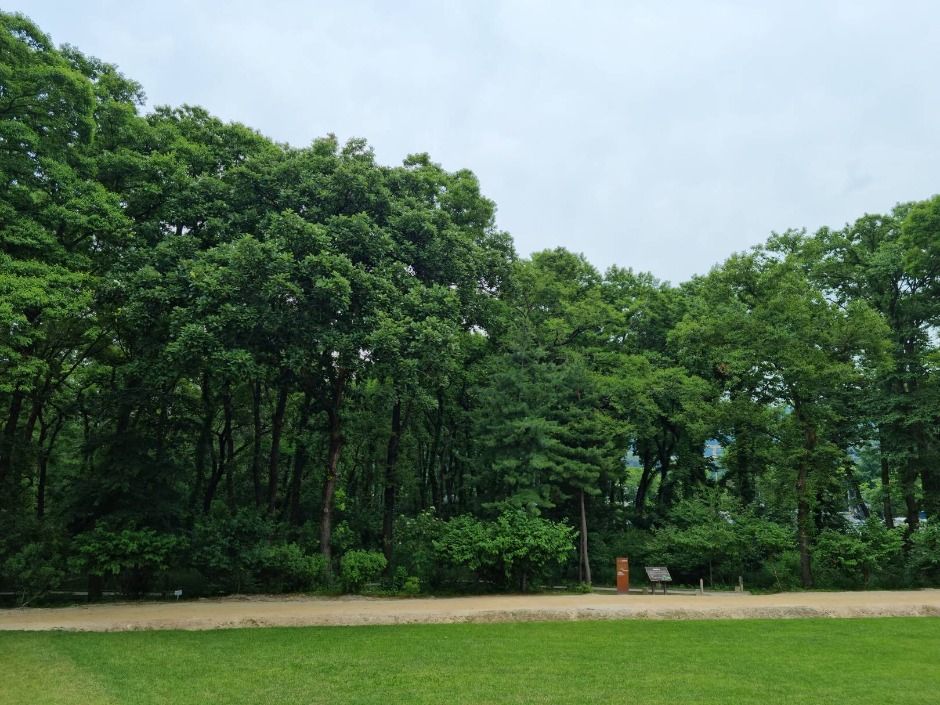
Heolleung is the tomb of King Taejong (r. 1400–1418), the 3rd monarch of Joseon, and Queen Wongyeong of the Min clan (1365–1420). It is a twin tomb (雙陵) with two burial mounds placed side by side within a single curved wall. When viewed from the front, the left (west) mound is King Taejong's, and the right (east) mound is Queen Wongyeong's. In 1420 (the 2nd year of King Sejong's reign), Queen Wongyeong passed away first, and her tomb was built at the current site. When constructing her tomb, King Taejong had his own burial site prepared in advance. Two years later, in 1422 (the 4th year of King Sejong's reign), King Taejong died, and his tomb was built to the west of Queen Wongyeong's, resulting in the present arrangement.
Both burial mounds are surrounded by stone screens (byeongpungseok) and railings (nananseok). The stone screens are carved with the twelve zodiac animal deities, vajra (yeongjeo), and vajra bells (yeongtak). Around the mounds are placed stone figures of civil officials (munseokin), military officials (museokin), stone horses (seokma), stone pillars (jeongjungseok), long-life lanterns (jangmyeongdeung), stone tables (honyuseok), stone pillars (mangjuseok), stone sheep (seogyang), and stone tigers (seokho). Notably, the number of civil officials, military officials, stone horses, stone sheep, and stone tigers is double that of other royal tombs, following the system of the Hyeon and Jeong tombs of King Gongmin of Goryeo and his wife Princess Noguk. Below the tomb, in the stele pavilion (sindobigak), there are two steles: one erected after King Taejong's death and another erected in 1695 (the 21st year of King Sukjong's reign) to replace the original stele that had been damaged.
OTA-ready stop
Built into inbound routes and day-tour planning.
Local context
서울특별시 서초구 헌인릉길 34 (내곡동)
Travel fit
Attraction · Seoul


![[Early bird] Elysian Gangchon Ski & Snowboard Gugok Ice Wall Tour](/_next/image?url=https%3A%2F%2Fadmin.holidaykr.com%2Fapi%2Fadmin%2Fsystem%2Fbasic-settings%2Ffavicon%3Fpath%3D%252Fuploads%252Fproducts%252Fthumbs%252F750_1792085658746_file1.webp&w=3840&q=75)